
Ilija Matusko
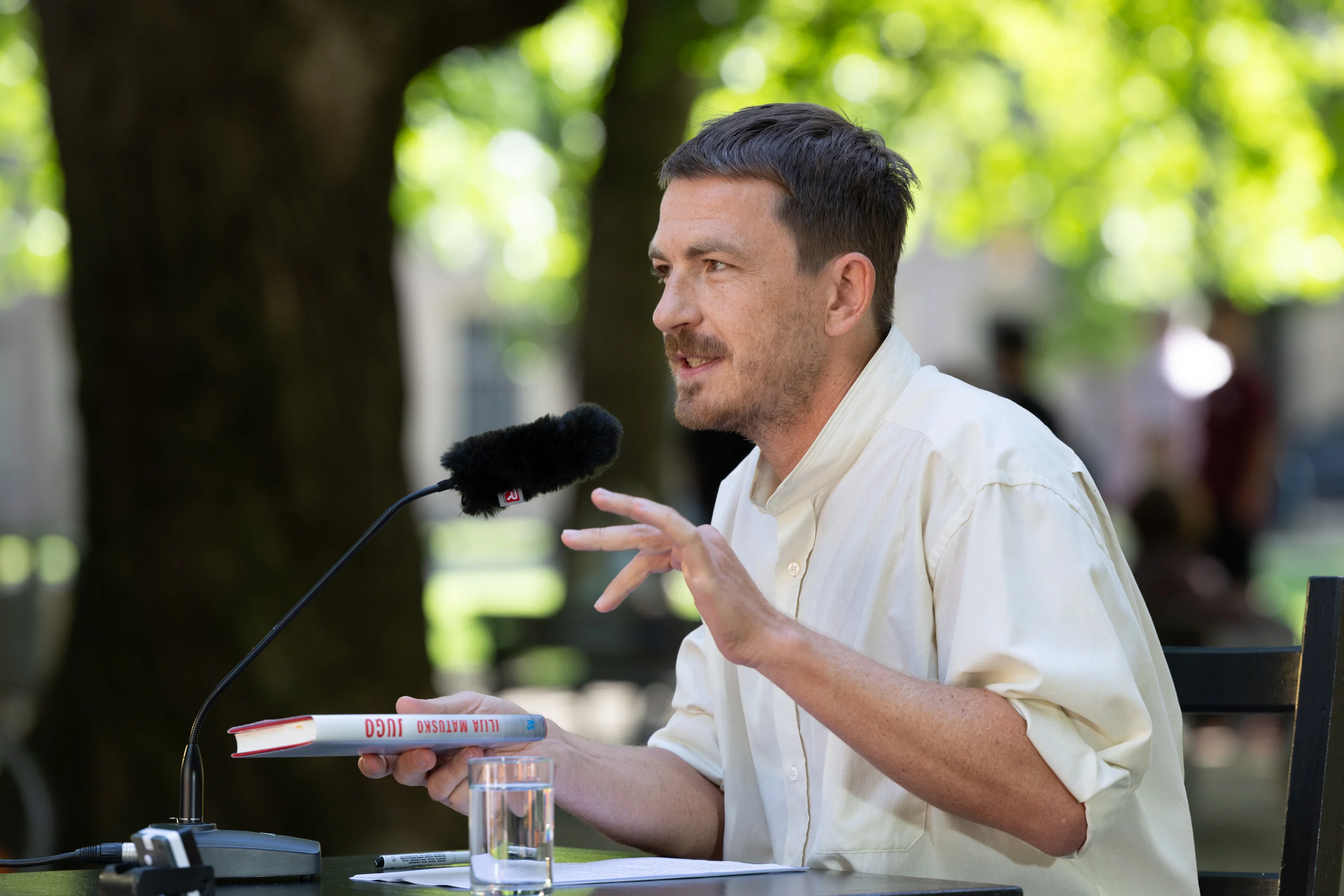
Image from Wikipedia
Image from Wikipedia
Ilija Matusko – Literature on Origin, Work, and Identity
An author who transforms social reality into precise language
Ilija Matusko, born in 1980 in Munich, is one of the distinctive voices in contemporary German-language literature. His work revolves around social origin, classism, work, and identity, gaining power from the connection between personal experience and sociological observation. Matusko lives and works in Berlin; he studied sociology, political science, and social psychology at Ludwig Maximilian University of Munich. ([de.wikipedia.org](https://de.wikipedia.org/wiki/Ilija_Matusko))
Biography: From the Munich milieu to literary self-examination
The biographical imprint in Ilija Matusko's life is not a decorative motif but the central resonance space of his literature. He is the son of a Croatian-Bosnian father and a German mother; his parents ran an inn in Bavaria. This origin story, growing up amid work, smells, family business, and social shifts, forms the emotional core of his writing. ([de.wikipedia.org](https://de.wikipedia.org/wiki/Ilija_Matusko))
It is precisely this background that makes his texts so compelling: Matusko does not write abstractly about class, but from an experience that condenses into everyday scenes, feelings of shame, and narratives of social ascent. Deutschlandfunk Kultur describes his book as a story of upward mobility that begins with a question of social origin; even in Suhrkamp materials, the family story is at the center. ([deutschlandfunkkultur.de](https://www.deutschlandfunkkultur.de/verdunstung-in-der-randzone-wenn-die-soziale-herkunft-nach-pommes-riecht-dlf-kultur-5fa5264a-100.html))
Career: Literature as a precise observation of the working world
His literary career is closely linked to writing about societal borderlands. Matusko published his debut Verdunstung in der Randzone in 2023 with Suhrkamp, followed by his novel debut Jugo in 2026. Additionally, he works as a freelance writer and writes for publications like taz; thus, he operates at the intersection of literary prose, journalistic observation, and cultural critique. ([suhrkamp.de](https://www.suhrkamp.de/person/ilija-matusko-p-17444?utm_source=openai))
For his work, he has received several scholarships and residency grants, including from the Fritz-Hüser-Institut, Villa Aurora in Los Angeles, Alfred-Döblin-Haus, the Künstlerdorf Schöppingen, and the Künstlerhof Schreyahn. In 2020, he was awarded the Irseer Pegasus Literary Prize. These stages mark an author whose profile has developed not through loud self-presentation but through continuity, thematic sharpness, and institutional recognition. ([de.wikipedia.org](https://de.wikipedia.org/wiki/Ilija_Matusko))
Development of work: From debut to novel art
Verdunstung in der Randzone represents Matusko's literary breakthrough as the text combines personal memory with analytical distance. Suhrkamp describes the book as ten essayistic chapters about a social climber, written with a "keen eye for the fine distinctions," infused with wit and literary power. The starting point is a sentence from the author's youth that runs like a stigma throughout the book, elevating the smell of work and social attribution to a poetic motif. ([suhrkamp.de](https://www.suhrkamp.de/buch/ilija-matusko-verdunstung-in-der-randzone-t-9783518128107?utm_source=openai))
With Jugo, Matusko expands this perspective to familial tensions and the relationship between father and son. Suhrkamp announces the novel as the tale of a fractured family, where a son from Berlin spends his holidays at his father's house on the Adriatic coast. This creates a literary space where migration, belonging, alienation, and the question of the "in-between" converge in a new narrative form. ([suhrkamp.de](https://www.suhrkamp.de/buch/ilija-matusko-jugo-t-9783518433102?utm_source=openai))
Style: Sociological precision, literary tension
Matusko's style thrives on precise observation, clear language, and a strong proximity to social codes. His texts intertwine personal memories with reflections on class and ascent without tipping into theoretical prose. This creates a literature that remains close to everyday life while simultaneously making the mechanics of social exclusion visible. ([suhrkamp.de](https://www.suhrkamp.de/buch/ilija-matusko-verdunstung-in-der-randzone-t-9783518128107?utm_source=openai))
The poetic quality lies in the condensation of small details: smells, work processes, family rituals, and places become markers of a biography that does not follow a straight line. Matusko writes about the present not as a mere backdrop but as a space where origin, migration, and social experience coalesce. This lends authority and a clear literary fingerprint to his work. ([deutschlandfunkkultur.de](https://www.deutschlandfunkkultur.de/verdunstung-in-der-randzone-wenn-die-soziale-herkunft-nach-pommes-riecht-dlf-kultur-5fa5264a-100.html))
Reception and cultural context
The reception of his debut shows that Matusko strikes a chord with contemporary society. Deutschlandfunk Kultur highlights the story of origin and the shame associated with social attributions, while Suhrkamp emphasizes the literary impact and awareness of social differences. Reviews indicate that his writing is not only individually significant but also socially readable. ([deutschlandfunkkultur.de](https://www.deutschlandfunkkultur.de/verdunstung-in-der-randzone-wenn-die-soziale-herkunft-nach-pommes-riecht-dlf-kultur-5fa5264a-100.html))
Culturally, Matusko aligns himself with authors who treat educational ascent, class experience, and the working world not as marginal themes but as the center of contemporary literature. His books are therefore more than autobiographical reflections: they are precise seismographs of a milieu in which origin never entirely disappears. This connection between personal truth and social analysis makes him equally interesting to readers and literary critics. ([de.wikipedia.org](https://de.wikipedia.org/wiki/Ilija_Matusko))
Current projects and publications
Currently, the novel Jugo is particularly relevant, which was published on September 2, 2026, by Suhrkamp. Parallel to this, readings and event formats are taking place, for example, in Berlin and Frankfurt am Main. Thus, Matusko remains visible as an author whose work continues to be anchored in the public literary scene. ([suhrkamp.de](https://www.suhrkamp.de/buch/ilija-matusko-jugo-t-9783518433102?utm_source=openai))
His earlier book Verdunstung in der Randzone is still present and has been reissued in a current edition. This underscores the reach of the debut and shows that Matusko's themes do not lose their relevance: social origin, work, shame, and the difficult path out of the origin world remain central literary conflict lines. ([suhrkamp.de](https://www.suhrkamp.de/buch/ilija-matusko-verdunstung-in-der-randzone-t-9783518128107?utm_source=openai))
Conclusion: Why Ilija Matusko remains compelling
Ilija Matusko is compelling because he shapes literature from biographical experience with analytical sharpness. His texts tell not only an individual story but illuminate the mechanics of class, work, and identity in the German-speaking world. Those seeking contemporary literature that is precise, intelligent, and emotionally accessible will find in Matusko an author with a clear voice and growing relevance. ([de.wikipedia.org](https://de.wikipedia.org/wiki/Ilija_Matusko))
His readings and book publications also demonstrate that this is an author who understands literature as a living dialogue with the present. This is precisely the invitation: Ilija Matusko should not only be read but also experienced live, as his language gains intensity in direct delivery. ([suhrkamp.de](https://www.suhrkamp.de/buch/ilija-matusko-jugo-t-9783518433102?utm_source=openai))
Official channels of Ilija Matusko:
- Instagram: no official profile found
- Facebook: no official profile found
- YouTube: no official profile found
- Spotify: no official profile found
- TikTok: no official profile found
Sources:
Upcoming Events

Side Glance
JUGO – Reading with Ilija Matusko in Schwerin