
Johnny Cash
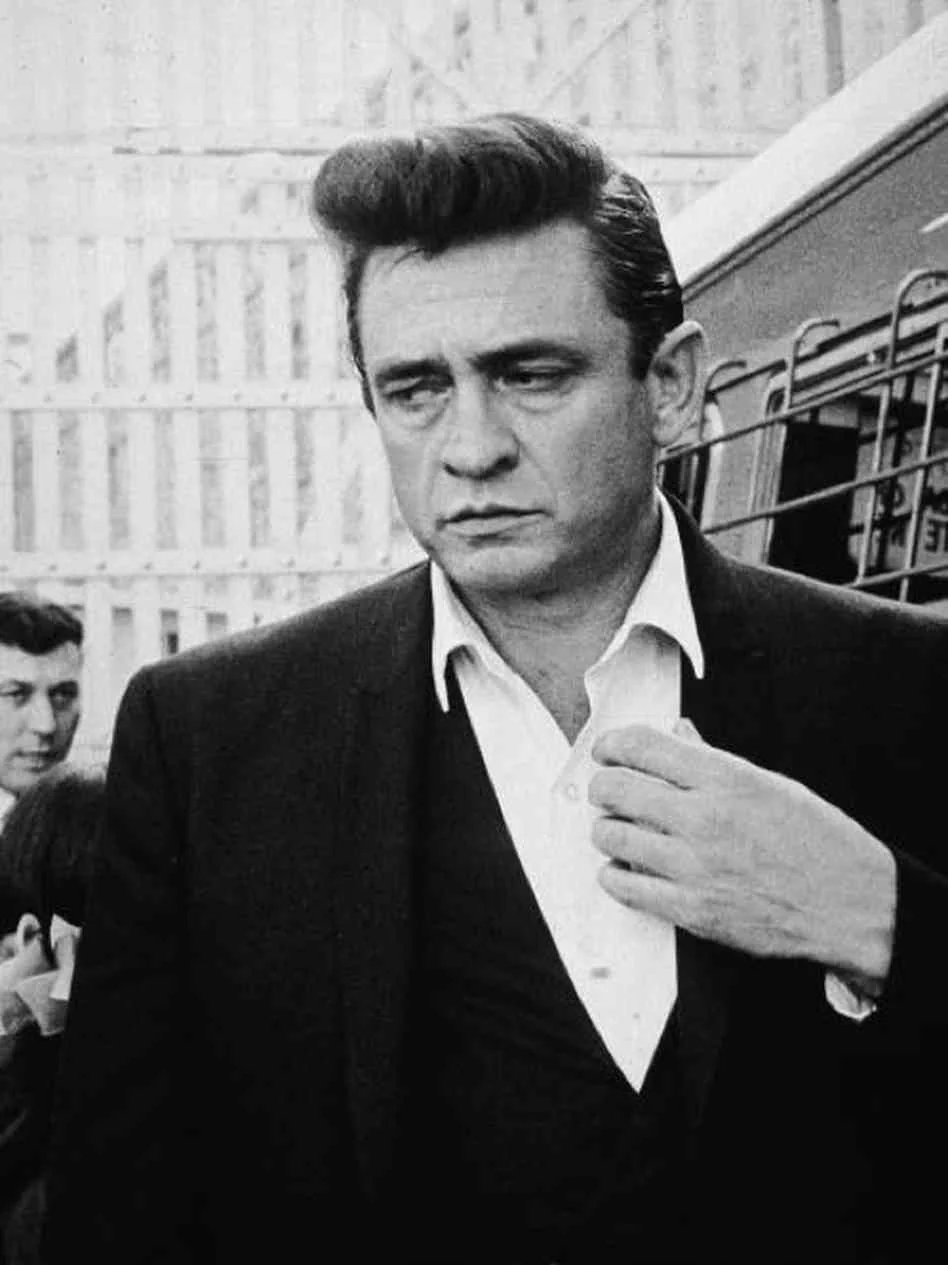
Image from Wikipedia
Image from Wikipedia
Johnny Cash: The Unmistakable "Man in Black" and the Voice of American Song
An Artist Who Redefined Country Music, Gospel, and Rebellious Truth
Johnny Cash is one of those rare musicians whose work transcends a single genre while remaining inextricably linked to it. As a singer, songwriter, and stage personality, he shaped country, rockabilly, gospel, blues, and folk with a clarity that resonates to this day. His distinctive bass-baritone voice, the sparse, driving “Boom-Chicka-Boom” sound, and often unyielding lyrics made him one of the most influential figures in popular music of the 20th century.
Born on February 26, 1932, in Kingsland, Arkansas, Johnny Cash grew up during the harsh years of the Great Depression. This background shaped his views on family, faith, work, and truth, infusing his art with a blend of empathy and severity that makes his songs so distinctive. Cash was more than a country star: he became a cultural authority, a narrator of American contradictions, and a voice for outcasts, believers, skeptics, and seekers.
Biographical Roots: Arkansas, Poverty, and the Inner Compass
John R. Cash came from a family of sharecroppers in Arkansas, and this social reality remained audible in his work. The experience of deprivation, hard work, and religious influence shaped an artist who never confused simple truths with simplicity. It was from this foundation that he developed the ability to transform everyday conflicts into great songs that resonate both folklorically and literarily.
After serving in the U.S. Air Force as a radio intercept operator, Cash initially tried his hand at various civilian jobs before being fully embraced by music. This indirect path enhanced his profile as a distinct artist who did not come from the comfort zone of show business but from experience, observation, and resistance. Early on, he fused personal authenticity with a strict, almost ascetic form of performance.
Breakthrough at Sun Records: Reduction as Strength
In 1955, Johnny Cash achieved his breakthrough at Sun Records in Memphis, the legendary place where country, blues, and early rock impulses intersected. With titles like “Hey Porter,” “Cry! Cry! Cry!,” “Big River,” “I Walk the Line,” and “Folsom Prison Blues,” he crafted a style focused on the essentials. These songs represented a new, succinct directness in country, driven by rhythm, attitude, and narrative precision.
The early Cash sound, reinforced by his minimalist backing musicians, was less ornamental and more striking and compelling. That was where his power lay: he did not need extravagant production to create tension. His music thrived on pulse, voice, and a dramatic simplicity that worked equally well on stage as it did on record.
Columbia Years and Artistic Expansion
After moving to Columbia Records in 1958, Cash significantly expanded his musical spectrum. Although more hits followed, such as “Don’t Take Your Guns to Town” and “Ring of Fire,” the true artistic significance of this phase lay in his concept albums and thematically rich programs. Works like Ride This Train, Blood, Sweat and Tears, Bitter Tears: Ballads of the American Indian, and Ballads of the True West showcased a musician who took country as a narrative art form seriously and did not shy away from social issues.
Cash approached folk, cowboy songs, gospel, and songs with social critique without losing his identity. This openness made him one of the rare artists who not only transcended genre boundaries but also transformed them productively. His music career thus evolved from a hit-making machine to a multi-voiced American songbook.
Folsom Prison, San Quentin, and the Birth of the Legend
The legendary prison concerts at Folsom and San Quentin are central moments in pop and country history. With these performances, Cash created not merely a sensation but an artistic condensation of his entire work: compassion for the marginalized, a connection to reality, and an unwavering belief in the transformative power of song. The live albums made him an even greater figure and endowed his songs with an existential urgency.
The live recordings radiate not only musical strength but also moral authority. Cash did not appear as a distant entertainer but as someone who made the cracks in the American dream audible. These concerts cemented his reputation as an artist with extraordinary stage presence and as an interpreter who met people on equal footing.
The 1960s and 1970s: Television, Duets, and Cultural Reach
With The Johnny Cash Show, which debuted in 1969, Cash reached a mass audience and showcased not only himself but also a wide range of musical guests. The show combined classic country elements with new voices and underscored his status as a musical bridge-builder. Cash acted here as a host, curator, and national storyteller all at once.
Simultaneously, he expanded his career into film and television, further strengthening his cultural presence. His discography remained vibrant and hit-rich; he achieved a total of 13 number-one singles in the country charts, from “I Walk the Line” to “One Piece at a Time.” This track record makes it clear that Cash was not only an icon of attitude but also an extraordinarily successful hit interpreter.
Style, Voice, and Themes: The Sound of Truth
Johnny Cash's style is instantly recognizable: deep, dry, rhythmic, unobtrusive yet maximally present. His bass-baritone lent even simple arrangements a weight that oscillated between comfort, threat, and confession. Together with the precise, reduced playing of the Tennessee Three, he created that characteristic pulse that made his songs unmistakable.
Content-wise, his songs revolve around guilt, redemption, faith, work, freedom, love, and loss. Cash wrote about 500 songs, addressing not only personal conflicts but also social issues, religious tensions, and the inner turmoil of the American self-image. This combination of composition, attitude, and narrative craft explains his enduring significance for musicians of various generations.
Late Renaissance with Rick Rubin and the Second Great Career
After periods of lesser commercial resonance, Cash experienced an impressive artistic rebirth in the 1990s. With Rick Rubin and the American Recordings, he placed the naked voice and the essence of the song at the center. This late chapter made him relevant to a new audience and proved that artistic authority is not bound to youth.
Particularly the album American Recordings from 1994 received extensive acclaim and was celebrated as a significant comeback. This was followed by Unchained, American III: Solitary Man, and American IV: The Man Comes Around, which once again earned Cash Grammy awards. The late hit “Hurt” brought his intensity to a younger audience and became one of the most striking music videos in history.
Discography, Awards, and Critical Reception
Cash's discography encompasses an impressive range from Sun and Columbia recordings to live milestones and late American albums, as well as posthumous releases. The official chart history documents the remarkable longevity of his catalog, in which alongside classics like “Ring of Fire,” “Hurt,” “A Boy Named Sue,” and “I Walk the Line,” later re-entries and downloads also become visible. This ensures that Cash remains not only historically relevant but also permanently present in the archive of popular culture.
His achievements have been recognized multiple times: 13 Grammy Awards, induction into the Country Music Hall of Fame, the National Medal of Arts, and other honors mark a career of extraordinary reach. Critical voices continue to emphasize his ability to transform American music into existential art. It is precisely the combination of commercial success, artistic integrity, and cultural impact that solidifies his authority in music history.
Cultural Influence: Why Johnny Cash Still Matters Today
Johnny Cash is considered one of the most influential country musicians of all time, because he not only catered to the genre but also stretched it, opened it up, and imbued it with moral weight. His work combined popular directness with literary depth, making him accessible to country fans, rock listeners, folk audiences, and later alternative country circles. He was an artist who did not merely conserve tradition but interrogated it productively.
His resonance extends far beyond the country scene into music, film, literature, and fashion. The “Man in Black” became a symbol of independence, compassion, and artistic consistency. Those who listen to Johnny Cash today encounter not only a legend but a living canon of American song culture.
Current Projects and Posthumous Releases
Even decades after his death, Johnny Cash's name remains present in the music industry. The official website references the album Songwriter, which emerged from previously unreleased recordings from 1993 and is set to be released in 2024. Additionally, the book The Complete Johnny Cash: Lyrics From a Lifetime of Songwriting is scheduled for release on October 14, 2025, extensively documenting his vast treasure trove of songs and private notebook pages.
These releases demonstrate the ongoing interest in Cash's work. His catalog is not only carefully preserved but continually reinterpreted and contextualized. For music lovers, this means Johnny Cash remains not an archive but a presence.
Conclusion: An Artist Between Hardship, Compassion, and Immortal Songwriting
Johnny Cash fascinates because he embodies contradictions: hardness and gentleness, rebellion and faith, popularity and depth, simplicity and artistic severity. His voice carries the story of a whole country, his songs tell of guilt, hope, and the possibility of redemption. This is why he remains one of the most reliable figures in music history.
Anyone who experiences Johnny Cash live in memory, in recordings, or in his iconic concert films quickly understands why his work continues to resonate so strongly today. He is not only a classic of country music but also an exceptional artist with an unmistakable stage presence and a timeless musical language. Johnny Cash is worth rediscovering time and again—and his songs deserve to be heard loud.
Official Channels of Johnny Cash:
- Instagram: https://www.instagram.com/johnnycash/
- Facebook: https://www.facebook.com/johnnycash
- YouTube: https://www.youtube.com/c/johnnycashofficial?sub_confirmation=1
- Spotify: https://open.spotify.com/artist/6kACVPfCOnqzgfEF5ryl0x?si=bdANHFWoQHav5qYTXc97Fg
- TikTok: https://www.tiktok.com/@johnnycash
Sources:
- Johnny Cash Official Site – Biography
- Johnny Cash Official Site – Homepage
- Johnny Cash Official Site – News
- Johnny Cash Official Site – Songwriter Album News
- Johnny Cash Official Site – The Complete Johnny Cash: Lyrics From a Lifetime of Songwriting
- Country Music Hall of Fame and Museum – Johnny Cash
- Official Charts – Johnny Cash
- Linktree – @JohnnyCash
- Wikipedia – Johnny Cash