Discover Zero Waste & Green Events in Karlsruhe
Zero Waste & Green Events: This is how Karlsruhe will celebrate sustainably in the future
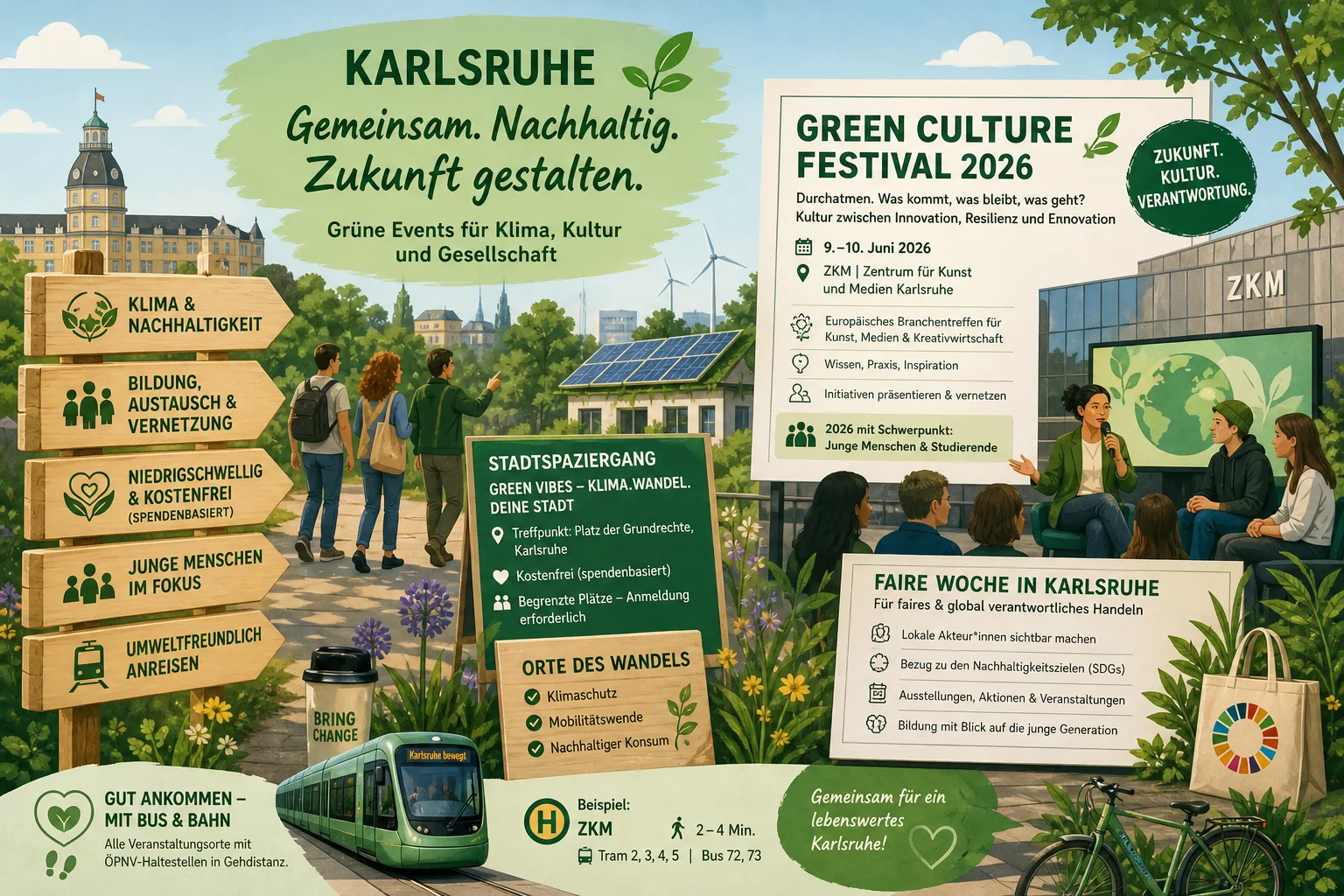
Karlsruhe is planning and designing more and more events in such a way that waste is avoided, resources are conserved, and climate-friendly travel is made easier. This overview shows how to recognize real Green Events, which zero-waste measures can be implemented immediately, and how to make your own event in Karlsruhe future-proof.
Which sustainable event trends will be relevant in Karlsruhe in the future?
For upcoming city and cultural formats in Karlsruhe, three developments are emerging in particular, which are reflected in many programs, calls for proposals, and audience expectations:
1) Sustainability becomes the “standard briefing”
Whether street festival, specialist congress, or cultural program: Sustainability criteria are increasingly being considered right from the basic planning stage (e.g. travel information, waste concept, reusable systems, fair procurement). This reduces later effort, as decisions are made consistently early on.
2) Learning formats become more experience-oriented
Instead of pure information transfer, many future formats rely on low-threshold participation: short inputs, hands-on stations, interactive tours, or workshop formats. This helps to convey zero-waste principles in everyday life and to promote lasting behavior.
3) Culture and creative industries focus on transformation
In the coming years, it is expected that industry meetings and specialist programs will increasingly bundle practical solutions for sustainable production, logistics, technology, and communication in cultural and media events. The focus is not only on innovation, but also on consciously reducing unsustainable routines (e.g. oversized technology, unnecessary transport, short-lived disposable materials).
Zero-Waste Toolkit for Events
Zero Waste in the event context means: Avoiding waste as much as possible from the outset and channeling unavoidable residual materials cleanly into cycles. For your next event in Karlsruhe, you can use these measures as a toolkit:
Planning & Material
- Omit before you replace: Decorations, giveaways, and printed products only if they serve a clear purpose.
- Reusable instead of disposable: Cups, dishes, cutlery, carafes/dispensers; plus a clear return logic.
- Borrow & reuse: Furniture, technology, partition walls, banner materials; modular systems save waste at follow-up events.
- Prioritize digital communication: Program info via QR code and accessible website; printing only as a supplement and targeted.
On-site waste separation
- Uniform, clearly visible collection islands: not too many variants, but clearly labeled and placed along walkways.
- “Why” short info: a short sign or announcement explaining how proper separation reduces residual waste.
- Team briefing: Brief helpers so that questions can be answered quickly and collection points do not “tip over”.
Catering without waste and unnecessary emissions
- Estimate needs realistically: Portion sizes, small-batch production, controlled planning of reserves.
- Offer vegetarian/vegan options visibly and attractively: this makes climate-friendly choices easier without compulsion.
- Water & drinks: Reusable bottles or tap water solutions (where permitted) instead of disposable.
- Manage leftovers: clear rules for distribution shortly before the end, take-away only if hygienically safe and well organized.
Climate-friendly mobility as part of event design
At events, a significant proportion of emissions often comes from arrival and departure. In Karlsruhe, you can achieve a lot through good information design without changing the program:
- Prominently feature public transport: Describe stops within walking distance, last departures after the event, and accessible routes.
- Make bicycle-friendliness concrete: Clearly signpost parking facilities, explain entrances/routes, and plan temporary bicycle areas if necessary.
- Car sharing & carpools only as a supplement: useful if there are public transport off-peak times or transport needs.
- Bundle delivery logistics: Time slots for setup and dismantling, consolidated deliveries, local service providers reduce transport.
Important: Mobility should not appear as a “note in the fine print”, but as a fixed part of your event story: “This is how you get there relaxed and with low emissions.”
Communicate credibly: Avoid greenwashing
If you announce an event as “Zero Waste” or “Green Event”, you must take the audience’s expectations seriously. Your communication is credible if it remains concrete, verifiable, and modest:
- Name concrete measures: e.g. “reusable system”, “digital program overview”, “collection islands with clear separation”, “public transport travel information in the invitation”.
- No absolute promises: better to say “we reduce” instead of “waste-free” if residual waste is realistically generated.
- Be transparent about limitations: e.g. official requirements, site conditions, safety requirements.
- Invite feedback: a short QR link to feedback helps to improve for the next event.
Sustainable event management means: systematically planning, controlling, and improving impacts – not just picking out individual measures.
Short checklist for your next event in Karlsruhe
If you want to quickly check for an upcoming event whether your concept is “green” enough, this compact list will help:
- Target image: Do you have 3–5 clear sustainability goals (e.g. reusable, public transport, less printed material, waste separation)?
- Location: Is the venue easily accessible by public transport and are bicycle parking spaces realistically usable?
- Reusable: Is there a functioning distribution system and an easy return process?
- Waste: Are collection islands placed along walkways and clearly labeled?
- Catering: Is vegetarian/vegan visible as a standard option and is quantity planning realistic?
- Communication: Are measures clearly explained (without exaggeration) and easy to find?
- Follow-up: Do you collect insights (e.g. short survey) to measurably improve the next event?
Sources & Standards
- ISO 20121:2012 — Event sustainability management systems — International standard for sustainable event management (accessed 2026-11-04)
- Umweltbundesamt (UBA): Waste & Resources — Basics on waste prevention and resource protection (accessed 2026-11-04)
- BMUV: Waste prevention — Political framework and principles for waste prevention (accessed 2026-11-04)
- United Nations: Sustainable Development Goals (SDGs) — Reference points for responsible procurement, climate protection, and sustainable cities (accessed 2026-11-04)