The History of Karlsruhe – Excitingly Told
Experience Karlsruhe's History in the Future: A Short, Exciting City Guide for Your Next Tour
Are you planning a visit to Karlsruhe in the coming weeks or months? This guide shows you how to experience the city's historical lines step by step in the future – across squares, axes, museums, law, science, and media art. No prior knowledge needed, but with a clear route.
Goal: In 2–4 hours you will discover a compact "history in urban space" – from the center outward, from architecture to institutions, from classical city planning to modern culture.
Preparation: How Your Tour Will Really Come Together in the Future
- Plan "City Center First": You'll find it easiest to start if you set a central square as your anchor and move outward in arcs from there.
- Set One Goal Per Topic: Architecture/square, institution (law or education), cultural venue (museum/media art) – this will make your day varied.
- Weather Options: You'll stay flexible with indoor stops (museums, exhibitions) in the rain; in sunshine, a route with parks and axis views is worthwhile.
- Plan for Accessibility: You'll get along well with public transport and short stages; check the official sites in advance for current information on access and elevators.
Route in Stages: How You Will "Read" the City Logic in the Future
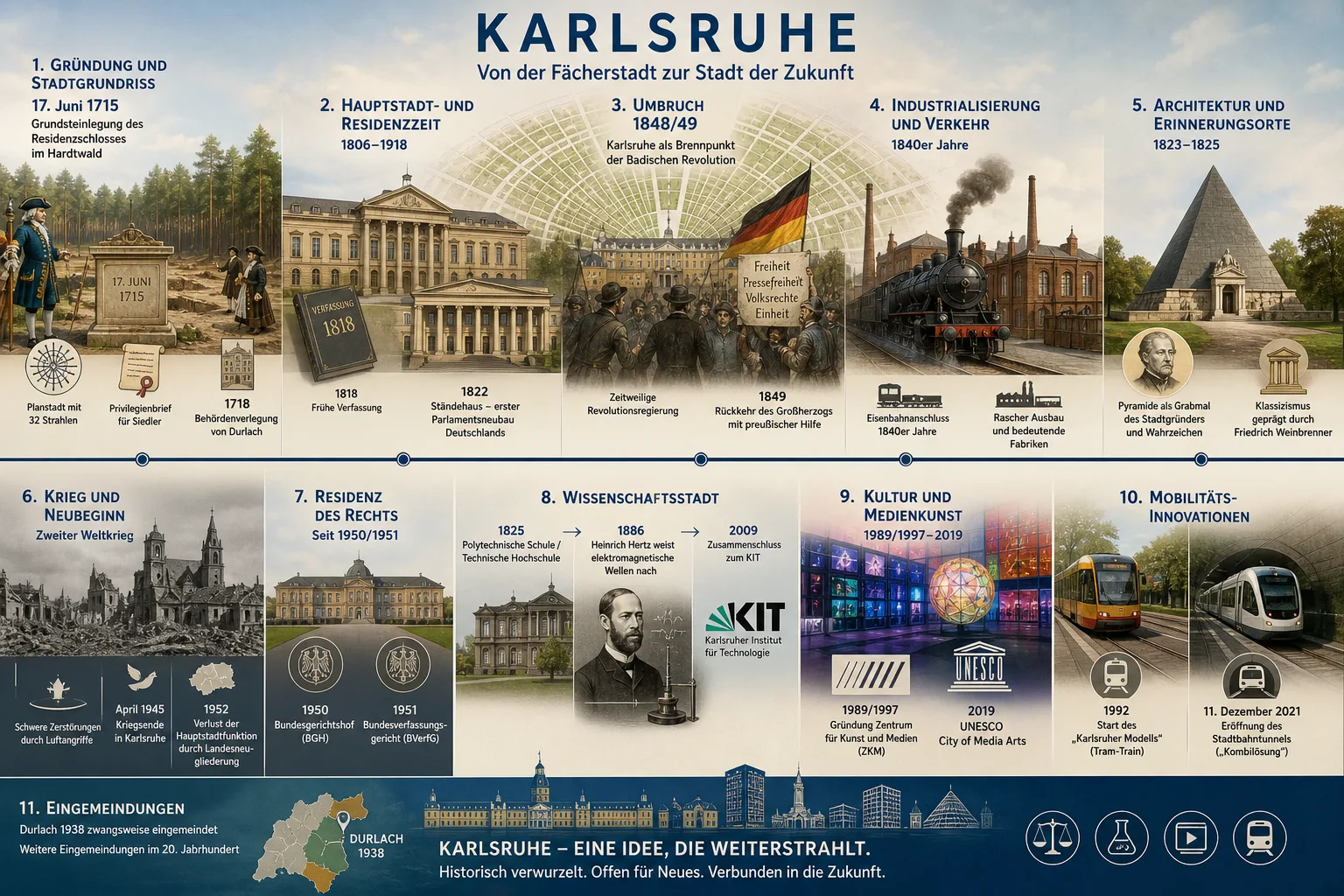
You will experience Karlsruhe most impressively if you understand the city as a narratable layout: central squares as chapter beginnings, sightlines as "punctuation marks," and institutions as topic changes. The following route is designed so that you can shorten or extend it in the future depending on your time budget.
Stage 1: Market Square & Pyramid – Your Entry Point
When you arrive at the market square in the future, you will find an ideal entry into the "city as a narrative space": Here you will observe symbolism, architecture, and everyday life all at once in a small area. It is precisely this overlap that makes historical places tangible today.
- What You Will Do: Stand at the edge of the square, scan the edges first (town hall/square fronts), then the center. This way you will quickly understand why some places have a "landmark character."
- What You Will Pay Attention To: Visibility from different directions, square proportions, photo spots, passages into side streets.
Stage 2: Axes & Perspectives – How You Use Orientation as a Story
On your upcoming walk you will notice: Karlsruhe works especially well when you use sightlines. You will remember a route more easily if you set fixed "view targets" (e.g., a striking building, a square edge, or a park entrance) and go from there to the next orientation point.
- Choose an Axis: You will decide on a well-walkable main connection.
- Set Intermediate Stops: Every 5–10 minutes you will make a short "sense stop" (look back, photo, note).
- Use Contrasts: You will experience changes between quiet/busy, old/new, stone/green as a narrative rhythm.
Stage 3: "Residence of Law" – What You Can Take Away On Site in the Future
If you explore Karlsruhe as the "city of law" in the future, you will take away one thing above all: legal institutions are not just abstract, they shape urban spaces, security zones, architectural languages, and the way people move in certain neighborhoods. Your visit will automatically become "social" – even without legal prior knowledge.
- This Is How You Will Experience It: You will encounter a quieter, more formal atmosphere, different pathways, and a noticeably different use of public space.
- What You Will Respect: You will observe photo/access rules and restrict yourself to signposted public areas.
- Added Value: After this section, you will perceive the city less as a "backdrop" and more as a "functioning state in everyday life."
Note: If you plan a guided tour or a visit to publicly accessible areas, you should check the official information pages in advance, as access, security rules, and opening hours may change.
Stage 4: Science & Campus Flair – Future Questions You Will Experience
On your next tour you will also perceive Karlsruhe as a science location: You will experience neighborhoods where people learn, research, found companies, and discuss – and you will notice that "city history" here is not only shown in stones, but in a culture of experimentation.
- What You Can Do in the Future: You will look for public lectures, exhibitions, open events, or science formats that welcome visitors.
- What You Will Pay Attention To: Notices, event calendars, information on public spaces, libraries, or exhibition areas.
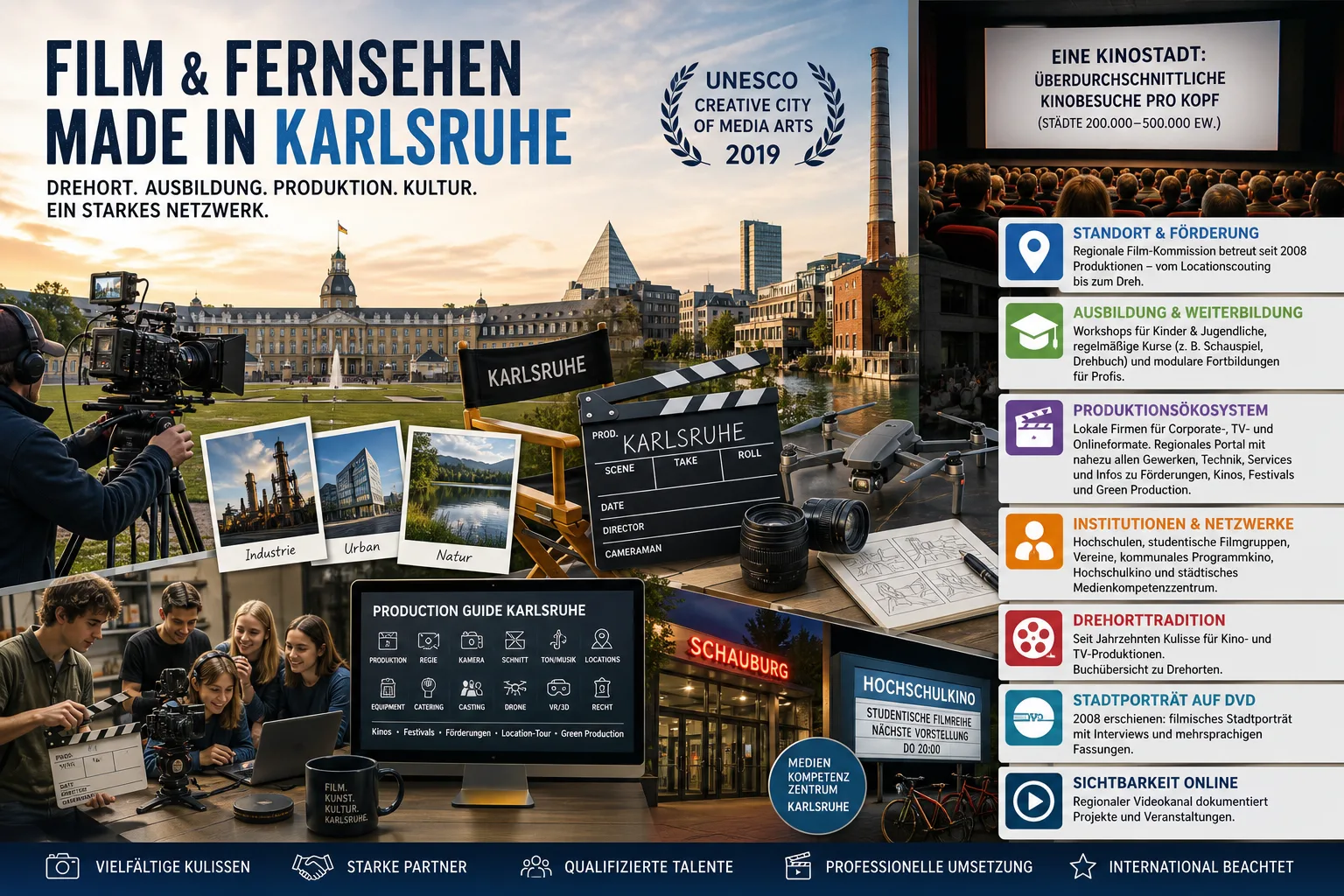
Stage 5: Media Art & Digital Culture – Your Creative Contrast
If you plan media art in Karlsruhe in the future, you will experience a strong contrast to the classic city tour: You will not only "look," but often also "interact" – and you will take away questions that go far beyond art (e.g., perception, data, public sphere, technology).
- This Is How You Will Do It: You will plan at least 60–90 minutes for an exhibition so that you don't just "walk through" installations.
- Tips for the Visit: You will check tickets/time slots in advance and observe photo/audio instructions on site so that you can move safely in the exhibition spaces.
On your upcoming Karlsruhe day, media art will probably be the section where past (city structure, places, symbols) and future (technology, society, digital culture) "touch" most directly.
Stage 6: Mobility in Everyday Life – How You Will Move Smartly in the Future
You will experience Karlsruhe particularly relaxed if you see mobility as part of your story: Not just "from A to B," but as a conscious element of your day. Depending on the route, you will switch between walking, tram/light rail, and possibly bicycle – and thus collect different city impressions.
- Short Distances: You will cover many central sections on foot and discover details that disappear when passing by.
- Medium Distances: You will save time with public transport and still keep the "city feeling."
- Planning: You will check connections shortly before departure, as construction sites, detours, or schedule changes are possible.
Practical Tips for Your Upcoming Visit
This Is How You Will Structure Your Day Pleasantly
- 2 hours: Market square + axis walk + a short culture stop.
- 3–4 hours: Plus: a museum/exhibition visit and an additional topic block (law or science).
- Whole day: Plus: park/garden section, second exhibition, or a guided tour.
What You Will Pay Attention to in the Future (for a Reliable Experience)
- Opening Hours & Tickets: You will double-check them on the day of your visit.
- Arrival: You will allow for buffer time in case schedules change at short notice.
- Data Protection & Photos: You will respect rules in institutions and exhibitions that protect people and works.
Note (Transparency): This guide is a visit and experience plan for future city tours and does not replace up-to-date information from the respective operators. For binding information, please use the official websites.
Sources & Further Links
- City of Karlsruhe – Official Website — Current information on the city, services, and notices (accessed 2026-08-19)
- Karlsruhe Tourism — Visit planning, tours, highlights, and current tips (accessed 2026-08-19)
- ZKM | Center for Art and Media Karlsruhe — Exhibitions, tickets, visitor information (accessed 2026-08-19)
- Karlsruhe Institute of Technology (KIT) — Events, public information, campus notes (accessed 2026-08-19)
- KVV – Karlsruhe Transport Association — Connections, timetables, current announcements (accessed 2026-08-19)