Baden Camino: Stage Ideas for Your Next Start
If you want to join a supra-regional pilgrimage network in the coming weeks, the Baden Camino is an obvious choice. For your planning, this means: you can start with a single day stage and add further sections later.
Stage Ideas for the Next Weekends
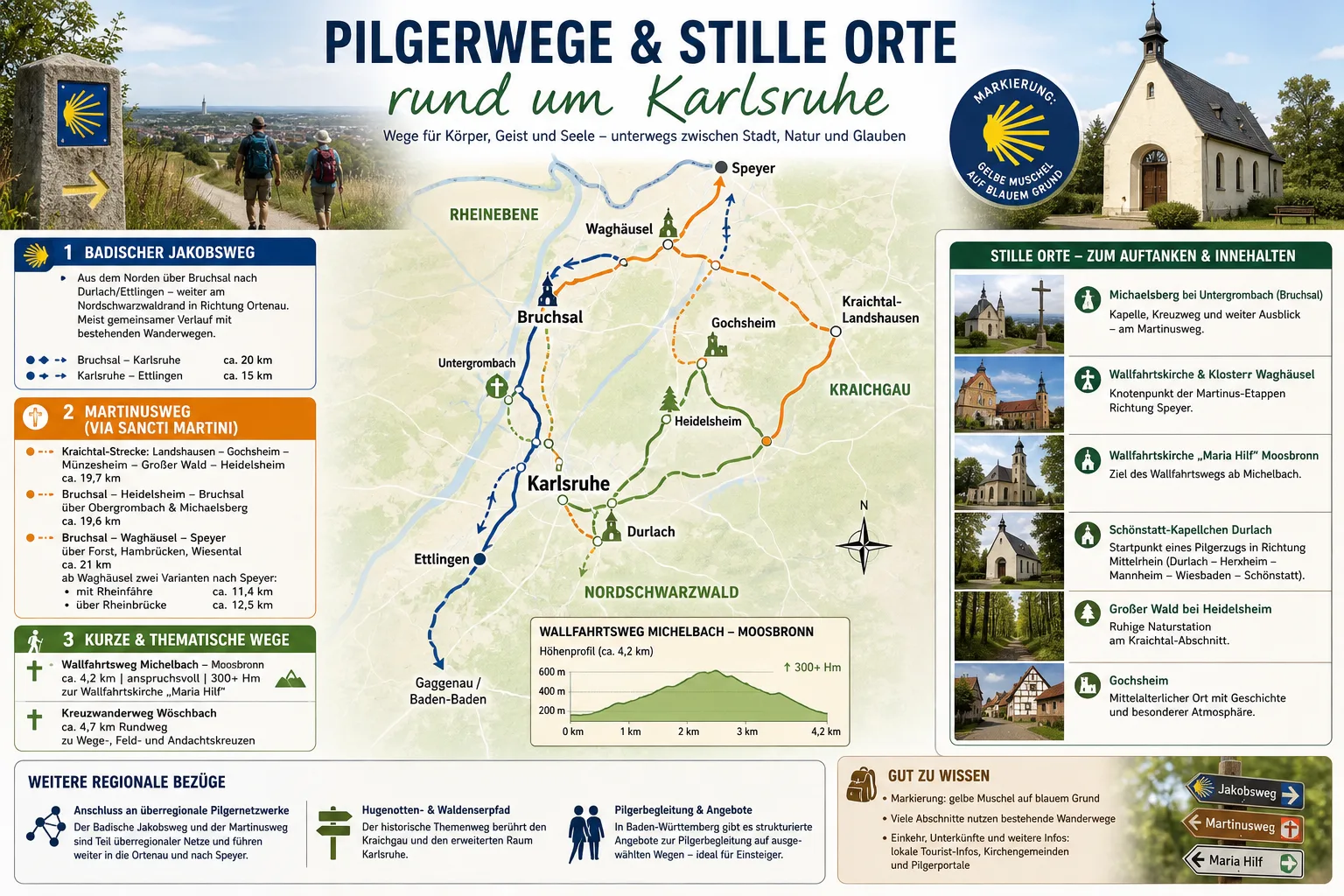
Bruchsal → Karlsruhe : about 20 km – makes sense if you want to tackle a full day stage.Karlsruhe → Ettlingen : about 15 km – well suited as a first pilgrimage day with a bit more room for breaks.
What You Can Orient Yourself By Along the Way
For your next tour, it is worth paying attention to the markings in advance (often: shell symbolism on Camino routes) and also having a map or track with you. This keeps you flexible if you want to spontaneously shorten or extend your stage.
How to Make a Multi-Day Route Out of It
If you are planning a small pilgrimage trip for 2026/2027, you can combine the day stages so that you can easily reach a train or bus connection in the evening. This makes it easier to get started without having to organize luggage logistics or long transfers right away.
Martinusweg: Day Stages in Kraichgau and Towards the Rhine
For your next pilgrimage days with peaceful landscape changes, the Martinusweg (Via Sancti Martini) is a good alternative or addition. It is especially suitable if you prefer stages with moderate distances and many intermediate places for the coming months.
Kraichtal/Surroundings → “Großer Wald” Towards Heidelsheim (Planning Idea)
If you want to aim for a day stage of around 20 km soon, the route through places with good intermediate connections is a practical concept: you can choose the start and finish so that you can shorten at any time in case of a change in weather or time pressure.
Plan a longer quiet break in a forest section (shade, muffled sounds, steady pace).
Set a clear intermediate point (e.g. village center, church, bench on a field path), so you don’t just “march through”.
Bruchsal → Waghäusel (Planning Idea)
For a future stage of about 20–22 km, a route towards Waghäusel can be a fitting day’s destination, as you can consciously arrive there (rest, quiet finish, possibly return trip). If you want to continue planning afterwards, you can design the next day so that you continue the transition towards the Rhine/further network at your own pace.
Short & Intense: Two Half-Day Routes for Your Next Break
Not every upcoming pilgrimage experience has to be multi-day. If you are looking for an intense but short break for the near future, short routes with a clear dramaturgy are ideal: start – ascent or loop – conscious destination.
Pilgrimage Route Michelbach → Moosbronn (approx. 4.2 km, approx. 300 m elevation gain)
If you want to tackle something challenging on a small stretch soon, this route is a suitable choice: the ascent is demanding, and it is often from this that the change from “full head” to “clear head” arises. Plan enough water and walk consciously slowly so that you arrive at the top without “pushing through”.
The pilgrimage church “Maria Hilf” in Moosbronn is a good destination to end the route with a quiet phase (sitting, breathing, gathering your gaze) before returning.
Cross Pilgrimage Path Wöschbach (approx. 4.7 km circular tour)
If you are looking for a loop in the coming days that can also be done after work or on a short morning, the Cross Pilgrimage Path is a good option. The focus is less on elevation or distance and more on attention: wayside crosses, field margins, small interruptions while walking.
For the best effect: walk the loop without time pressure, keep your phone in your pocket as much as possible, and set yourself a simple “pilgrimage rule” (e.g. don’t speak or listen to music for the first 20 minutes).
Quiet Places You Can Consciously Head For in the Future
For your next pilgrimage plans, it is worth thinking not only about “distance” but also about “place”. The following spots are suitable as conscious arrival or break points – especially if you want to walk your tours repeatedly or build them up in stages in 2026/2027.
Michaelsberg (Bruchsal/Untergrombach) : Good as a destination for an upcoming day stage with a view and a longer rest.Pilgrimage Area Waghäusel : Useful as a quiet finish if you are planning a stage towards the Rhine soon.Pilgrimage Church “Maria Hilf” (Moosbronn) : Ideal as a destination for a short, intense tour with an ascent.Schönstatt Chapel (Karlsruhe-Durlach) : Practical if you are looking for a quiet place near the city for a short start soon.Forest Sections Towards Heidelsheim (“Großer Wald”) : Suitable if you want to consciously plan “forest silence” as part of your stage in the coming months.
Planning Tip for the Next Tour: Choose one quiet place as your main destination in advance (not several). This makes the stage calmer and the decision easier along the way.
Practical Planning for Your Upcoming Pilgrimage Days
1) Choose Distance Realistically
If you are starting soon, 12–18 km is a good range for many people. For sporty days, 20–25 km can fit – but be sure to plan breaks. Short routes (4–6 km) are ideal if you consciously want to “pilgrimage intensively rather than long”.
2) Safety and Weather (for the Coming Months)
Check weather, daylight, and path quality in advance (especially for forest and slope sections).
Bring water, small snacks, blister plasters , and a thin extra layer.
If you are walking alone: share your planned route and return time with someone.
3) Plan Arrival and Departure to Stay Flexible
For the next tours, it is often more relaxed to choose start and finish so that you can shorten if necessary (e.g. through places with public transport connections). This reduces pressure and makes pilgrimage suitable for everyday life.
4) Build “Silence” as a Fixed Program Point
To make your next pilgrimage day truly relaxing, a simple structure helps: 10 minutes to arrive (start calmly), 20–40 minutes of steady walking , 5 minutes of conscious standing/sitting , only then pick up the pace again. This turns a hike into a pilgrimage experience.
For the coming routes, it often applies: the simpler the plan, the deeper the effect.
FAQ
Which Route Is Suitable as a First Pilgrimage Day Around Karlsruhe?
For your next start, a day stage of 12–18 km is ideal, for example Karlsruhe → Ettlingen (as a planning idea for the Baden Camino). This leaves enough time for breaks and orientation without the day becoming too long.
Can I Go on Pilgrimage Without Religious Affiliation?
Yes. For the upcoming tours, you can understand pilgrimage as a conscious walking practice: slowing down, sorting thoughts, perceiving nature. If you wish, use chapels or churches as quiet places – without being bound to any particular form.
How Do I Prepare for the Steep Pilgrimage Route Michelbach → Moosbronn?
Plan enough time for your next walk, go slowly, wear shoes with good grip, and bring water. Because the route is short but steep, a calm pace is more important than fitness. A short break before the final ascent helps many.
What Equipment Do I Need for a Day Stage?
For your next pilgrimage day, usually sufficient: comfortable, broken-in shoes, weather-appropriate layered clothing, water, small snack, sun protection, blister plasters, and a map/offline navigation. A small sitting mat can make breaks at quiet places much more pleasant.
How Do I Find Reliable Route Info (Markings, Maps, Route Guidance) for the Next Tour?
For the upcoming stages, it is best to use official or established information sites for the respective pilgrimage routes and supplement them with up-to-date maps/GPX tracks. Also check for possible detours shortly before starting (e.g. due to forestry work).
When Is the Best Time for Pilgrimage Around Karlsruhe in 2026/2027?
For your planning, spring to autumn is often particularly pleasant. In summer, early start times are advisable; in autumn, forest and high sections are often very atmospheric. Always pay attention to the weather and daylight so you arrive relaxed.