Citizens' Assembly in Karlsruhe: Experience City Politics
Experience Citizens' Assemblies & City Politics in Karlsruhe: How to Be Well Prepared for the Next Dates
Do you want to get closer to decisions affecting your district in Karlsruhe in the future – from traffic to housing to climate protection? At the upcoming citizens' assemblies (residents' assemblies), you can get first-hand information, ask questions, and bring your concerns into political consultation.
Note: This article is intended as guidance for future dates and procedures. Specific dates, locations, and agendas are published by the City of Karlsruhe.
1) What (Future) Citizens' Assemblies in Karlsruhe Are – and How They Help You
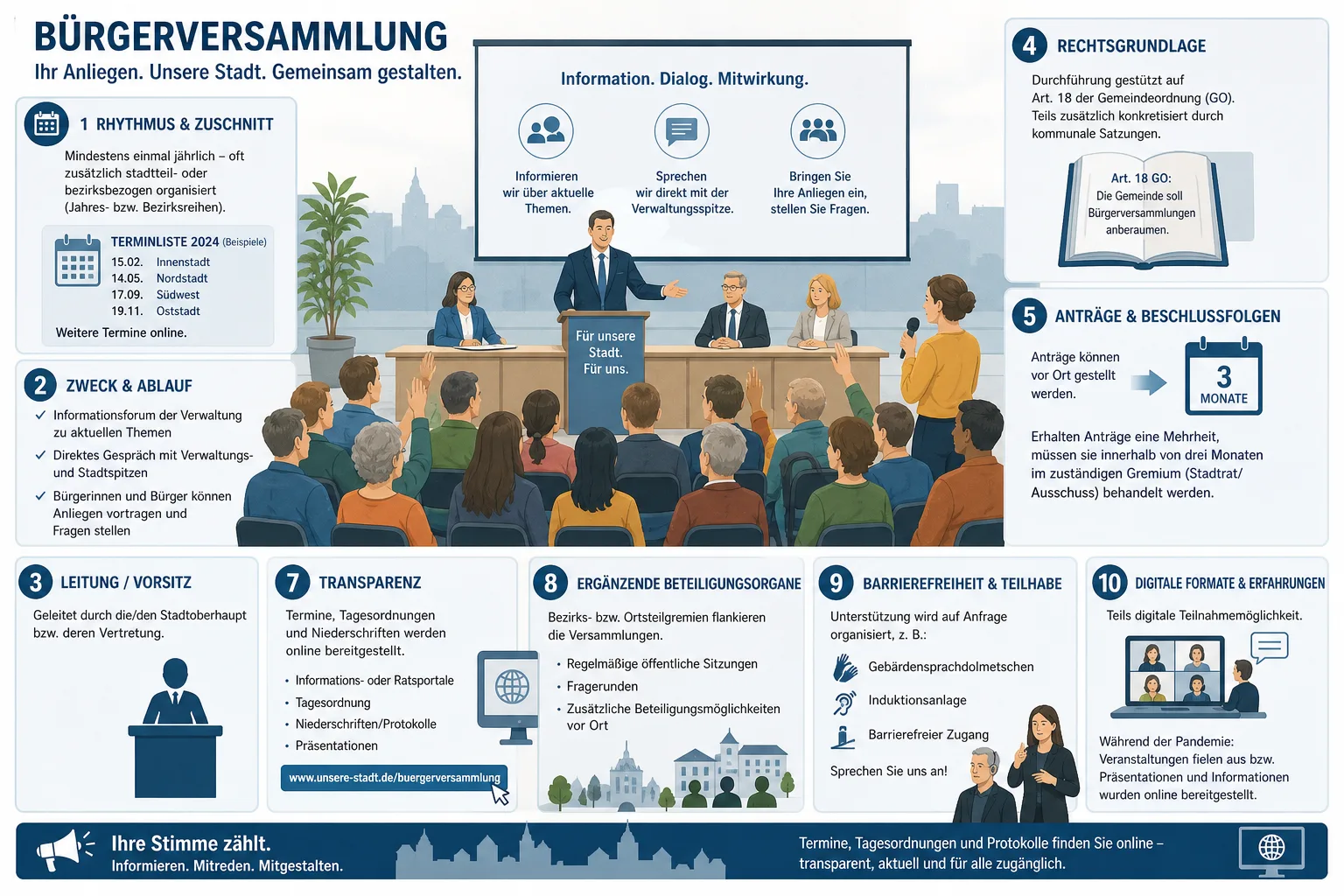
A citizens' assembly – often referred to as a residents' assembly in Baden-Württemberg – is a public participation format where residents enter into dialogue with the administration and city leadership. At the next events in Karlsruhe, you can expect to:
- have current and planned projects explained (e.g., urban development, mobility, schools, climate, neighborhood projects),
- ask questions about projects and address follow-up questions directly,
- bring up concerns from your everyday life (safety, noise, green spaces, construction site coordination) in a structured way,
- learn how things will proceed politically and administratively after the assembly.
Important: A citizens' assembly does not replace a city council meeting – but it is a strong format to make topics visible early and to follow the next steps transparently.
2) How to Find the Next Dates, Locations, and Agendas
To make sure you don't miss a date, it's worth establishing a routine. For the upcoming citizens' assemblies in Karlsruhe, you will usually find the most reliable information through official channels:
- Website of the City of Karlsruhe (sections on citizen participation, events, district information)
- Official Announcements / Official Gazette (depending on the city's publication method)
- Council and Citizen Information System (for subsequent consultations in committees/city council)
- Notices on site (citizen centers, district houses, public institutions – depending on the event location)
Check in advance especially:
- Agenda/Focus Topics: What topics are on the agenda, which are relevant to you?
- Format: In-person, possibly with supplementary online information, rules for speaking.
- Accessibility: Access, hearing support, possibly interpreting services (if offered).
3) Procedure of the Next Citizens' Assemblies: What to Expect On Site
The exact procedure is specified in the invitation. At the next events, you can typically expect four components:
3.1 Welcome & Framework
At the beginning, the purpose, rules (speaking times, order, moderation), and the evening's topics are explained. This helps you formulate your question appropriately.
3.2 Information Block on Current Projects
Administrative departments present planned or ongoing projects – often with maps, key figures, or timelines. Use this part to take notes: What decision is coming up next? Which department is responsible?
3.3 Question Round & Discussion
In the discussion, you can ask questions, express criticism, and make suggestions. A structure like this has proven effective:
- Context in 1 sentence: Where is the problem (location/impact)?
- Specific question: What should be answered (responsibility, schedule, alternative)?
- Request for next step: What do you expect (review, feedback, forwarding to committees)?
3.4 How Things Proceed After the Assembly
To ensure your concern doesn't remain unresolved, it's crucial how you follow up afterwards. Plan this already on site:
- Which office should respond to you (specialist department, moderation, citizen participation)?
- Where are results documented (minutes/record, presentation, summary)?
- When and in which committee can the topic be discussed next (committee/city council/district advisory council, depending on responsibility)?
4) Speak Up Effectively: How to Increase the Chance Your Point Will Be Followed Up
If you want your contribution to be pursued in the weeks after the assembly, these approaches will help you:
- Bring evidence: Photos (e.g., danger spot), brief measurement/observation notes (times, frequency), sketch of the situation.
- Make the impact concrete: “School route,” “delivery traffic,” “barrier at stop” is more tangible than “always bad.”
- Combine suggestion + review question: “Could a crossing aid be reviewed – and by when is feedback realistic?”
- Coordinate with others: If several people present the same problem in a structured way, the relevance becomes visible more quickly.
- Follow up: Note down keywords, names/functions and then specifically search in the council information system for consultations on the topic.
5) Accessibility & Participation: What You Should Clarify for the Next Dates
To ensure you can participate well, clarify as early as possible (at the latest after the invitation is published):
- Step-free access and accessible seating
- Hearing support (e.g., induction loop), if offered
- Easy-to-read language or understandable materials (depending on the offer)
- Support needs (e.g., accompaniment) and whom to contact for this
If you need support, an early request to the office named in the invitation is usually the best way – so the offer can be organized in time, if provided.
6) Transparency & Trust: How to Check Information After the Assembly
For reliable classification, a brief fact check via official documents is recommended after the event:
- Presentations/summaries of the event (if published)
- Templates and resolutions in responsible committees (council/citizen information system)
- Project pages of the city (timelines, participation steps, contacts)
This way you can track which points are taken up, which review assignments arise, and when decisions are likely to be made.