Accessible on the Go in Karlsruhe: Experience Inclusive Leisure
Accessible on the Go in Karlsruhe: Inclusive Leisure Ideas for the Near Future
A forward-looking overview of how Karlsruhe aims to make leisure, culture, and mobility more inclusive in the coming months and years – with digital orientation aids, more accessible routes, and offers for families, seniors, and people with disabilities.
Digital Orientation: a Planned Web App as an Accessibility Compass
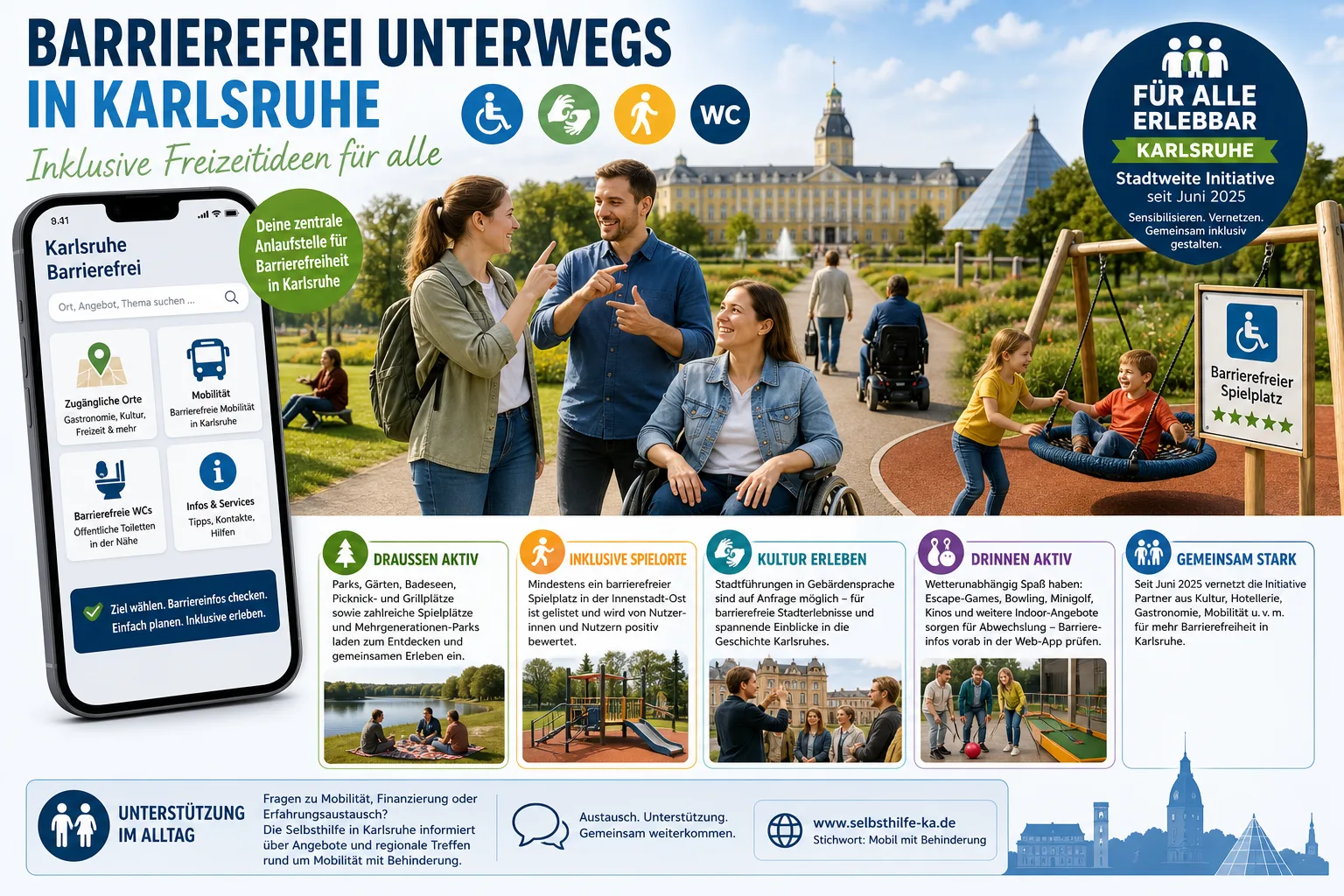
In the near future, Karlsruhe is expected to bundle information on accessibility more digitally: A web app or mobile overview (in line with the current trend in many municipalities) will bring together accessibility features in one place and make leisure planning more predictable.
Which Information You Should Check in Advance in the Future
- Steps and Ramps: step-free access, ramp length/slope, handrails.
- Doors and Passages: sufficiently wide doors, automatic door opening (if available).
- Elevators: location, door width, operability, outage notices.
- Accessible Toilets: access, opening hours, if applicable, Euro-key information (if relevant).
- Orientation & Communication: high-contrast signage, tactile elements, induction loops, easy language.
- Arrival: more accessible public transport connections, routes from the stop to the entrance, crossings.
How to Use Such an Overview Effectively in the Future
- Filter in Advance: Search specifically for the feature that is "decisive" for you (e.g. step-free or accessible toilet).
- Secure a Plan B: Set an alternative nearby in case an elevator is out of order or a toilet is closed.
- Give Feedback: If reporting functions are offered in the future, current information (e.g. construction sites) will be especially valuable.
Important: "Accessible" is often graded in everyday life. If a future app distinguishes between "step-free", "more accessible", and "limited usability", this helps with realistic decisions.
More Accessible Outdoors: Parks, Paths, Lakes (Outlook)
In the coming years, many cities are expected to focus on more accessible paths, safer crossings, and better quality of stay. For Karlsruhe, this mainly means: paths that can be used with mobility aids, more seating, and clearer route guidance.
What to Look for in Future Outdoor Destinations
- Path Surface: as even as possible, slip-resistant, and without loose gravel on main paths.
- Inclines: short, easily manageable climbs or alternative, flatter routes.
- Rest Zones: enough benches or quiet areas for breaks.
- Shade & Shelter: during heatwaves, shade infrastructure is becoming increasingly relevant.
- Sanitary Infrastructure: easily found, reliable toilets are key for many outings.
If you are traveling in a more accessible way, it will be especially worthwhile in the future to choose destinations not just by "nice", but by "works reliably": clear paths, short distances, safe crossings – and a retreat nearby.
Play & Inclusion: Inclusive Playgrounds (What Will Be Important in the Future)
Inclusive playgrounds are likely to become more of a focus in the near future: not as special areas, but as a normal part of neighborhoods. What matters is less a single piece of equipment and more the interplay of accessibility, play value, and social participation.
Features That Will Characterize Future Inclusive Play Spaces
- Accessible Paths: wide, easily navigable paths without thresholds.
- Ground-Level Play: offers that can be reached without climbing (e.g. sound and tactile games).
- Multi-Sensory Approach: visual, tactile, and acoustic stimuli in a balanced form.
- Retreat & Stimulus Reduction: areas with less noise/activity for breaks.
- Companion Friendliness: seating, good lines of sight, enough space to accompany.
For families, it will be especially helpful in the future if playgrounds are not only described as "accessible" but also usable: What can a child reach independently? Where is assistance needed? Such information makes outings more plannable and less stressful.
Culture & City Tours: More Accessible Access and Offers (Outlook)
In the near future, it is expected that cultural venues and organizers will treat accessibility more as a fixed part of program planning: with clear communication about access, more on-site service, and formats that take different needs into account.
Formats That May Be Offered More Frequently in the Future
- Tours with Sign Language Interpretation: especially for scheduled dates and on request.
- Offers in Easy Language: accompanying texts or introductions that increase comprehensibility.
- More Accessible Seating and Route Concepts: easily accessible seats, clear route guidance, break options.
- Improved Orientation: high-contrast signage and clearly recognizable paths.
For you as a visitor, it will be crucial in the future that information is reliably available before buying tickets or traveling: What is step-free? Where is the entrance? Are there assistance regulations? The clearer this information, the more inclusive culture will be in everyday life.
Indoor Leisure: More Accessible Experiences in Any Weather (Outlook)
Indoor offers are also expected to pay more attention to accessibility in the coming years – not only structurally, but also in process: understandable instructions, flexible team formats, and trained staff can reduce barriers.
Typical Indoor Activities – and What Matters for Accessibility
- Escape Formats: sufficient space to move, understandable instructions, if necessary, alternative puzzle routes.
- Cinema & Events: step-free routes, suitable seats, clear information about companions.
- Sports & Games: aid options (e.g. ramps/adaptations), clear safety rules.
- Museums/Experience Venues: easily accessible exhibits, orientation, break areas.
A practical principle for the near future: Good accessibility will increasingly be recognized as service quality. If a place communicates transparently how access works (and what does not), it builds trust and saves everyone stress.
Stronger Together: Networks, Feedback, and Participation (Outlook)
Accessibility is most reliably achieved when people with disabilities are consistently involved. In the coming period, local networks from tourism, culture, gastronomy, mobility, self-help, and urban society are expected to work more closely together – with the goal of not just "labeling" offers, but making them practically usable.
How You Can Contribute Constructively in the Future
- Share Observations: Where does it work well? Where does it fail due to details like thresholds, signage, or missing rest areas?
- Give Specific Feedback: "Door too heavy" is more helpful than "not accessible".
- Make Positives Visible: Good solutions (e.g. clear route guidance) increase the pressure to adopt standards.
If participation formats (workshops, citizen dialogues, test visits) are offered in the near future, it is especially worthwhile to get involved: everyday experience is expertise – and often improves measures faster than abstract requirements.
Checklist for Your Next Leisure Planning
This short checklist helps you plan outings to be more accessible in the future – regardless of whether you use the routes yourself or plan for family/friends:
- Clarify the Destination: Outdoors/Indoor? Quiet/busy? Short/long routes?
- Set a Decisive Feature: e.g. step-free, accessible toilet, quiet area, public transport proximity.
- Check Arrival: Stop, transfers, route from exit to entrance.
- Think About On-Site Process: Entry, ticket office, sanitary facilities, breaks, retreat, emergency exits.
- Define Plan B: Alternative nearby in case a detail does not work.
- Take Communication with You: request relevant information (e.g. need for assistance) in advance if possible.